
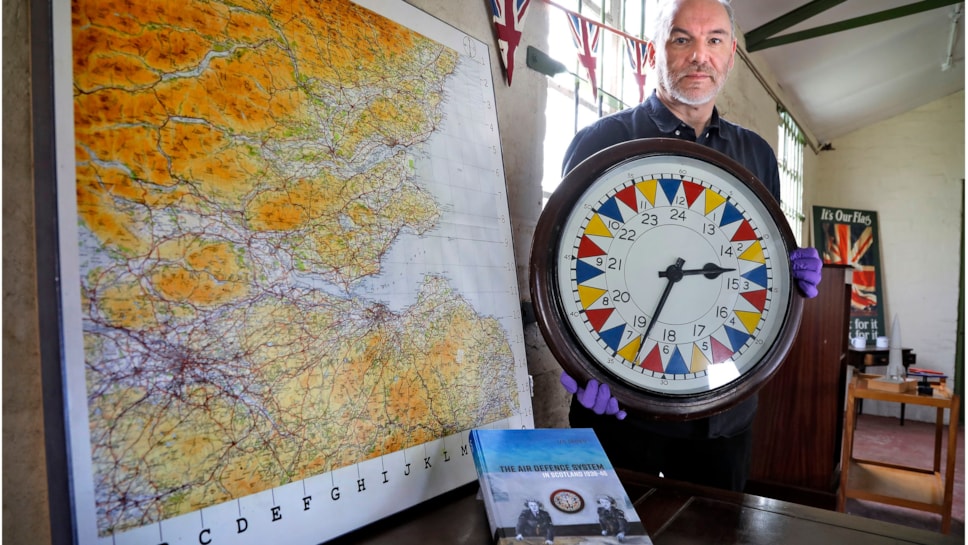
Untold story of Scotland’s wartime air defence system revealed
The remarkable and largely untold story of the air defence network in Scotland during the Second World War is revealed in a new book by the National Museum of Flight’s aviation curator, Ian Brown.
Press images are available here.
Published on 19 March, The Air Defence System in Scotland: 1938-46 traces the evolution of Scotland’s air defence network throughout the war, highlighting advances in technology and tactics and exploring how radar stations, Royal Observer Corps posts, and operations rooms worked together to detect and respond to incoming enemy aircraft.
Much has previously been written about Britain’s wartime air defences, but most accounts focus on the south east of England and the events of the Battle of Britain. This new work instead highlights Scotland’s vital strategic role in tackling the hostile air activity that occurred around the country throughout the war.
During the conflict, when weather conditions allowed flying, German aircraft were in the air around Scotland almost every day. The first air attack after Britain declared war on Germany took place in the Firth of Forth, and the first German aircraft shot down on British soil since the First World War fell over Scapa Flow.
The Air Defence System in Scotland: 1938-46, explains how the Royal Observer Corps, comprised almost entirely of volunteers, observed aircraft movements visually and by sound, passing information to Observer Group centres across Scotland including Galashiels, Glasgow, Dundee, Aberdeen, Inverness, Ayr, Dunfermline and Oban.
Reports from radar and observers were then filtered and analysed in operations rooms where highly trained teams rapidly interpreted the data to build an accurate picture of aircraft positions and movements. The process was complex and relied entirely on human skill. One small plotting error in this high-pressure environment could send pilots to the wrong location, making them miss an interception. It was also time-critical with information needed as early as possible to give fighter aircraft time to take off and climb to height.
The work of the Movement Liaison Organisation was also vital in tracking friendly aircraft from RAF Bomber and Coastal Commands so that British fighters were not scrambled unnecessarily to intercept their own aircraft.
The Air Defence System in Scotland: 1938-46 includes first-hand testimonies and rare wartime photographs, many never published before. A foreword by Former Air Officer Scotland (2014-2023) Air Vice-Marshal Ross Paterson (Retired) explains that the principles of Air Defence remain largely unchanged to this day and highlights the continued strategic importance of Scotland’s location on the UK’s Northern flank in maintaining control of the air.
Among the many stories featured is the tracking of Deputy Führer, Rudolf Hess, whose solo flight from Germany in 1941 in an apparently unauthorised peace mission, was plotted by the air defence system until his crash landing on Eaglesham Moor in Lanarkshire. The book also highlights how an intended joke in early April 1942 – the spotting at Drumnadrochit of a Monster at grid ref QJ 0549 (Loch Ness) travelling north-east at a height of one minus (below 1,000 ft) – was believed to be genuine and passed to the Inverness Filter Room.
The Air Defence System in Scotland: 1938-46 is the result of over 35 years of research by Ian Brown, aviation curator at the National Museum of Flight in East Lothian, itself a former Second World War airfield,
He said: “Scotland has a unique place in aviation history, yet the story of how its air defences operated during the Second World War has never been fully told. This book brings that story together for the first time, revealing how the people, technology and complex organisation behind the system worked together to defend Scotland’s skies. It was a truly impressive operation so as well as providing a comprehensive historical account, I hope the book will serve as a reminder of the gratitude we owe to all of the men and women who developed and operated this vital service.”
In addition to the air defence system, this new publication also explores the parallel network used to track shipping in Scotland’s coastal waters, monitoring hostile surface craft threatening convoys around the coast.
The Air Defence System in Scotland: 1938-46 is expected to be of particular interest to anyone interested in local and modern Scottish history as well as genealogists, aviation and military historians. The book is being published on 19 March by Sidestone Press, with the support of National Museums Scotland. It is a companion volume to Ian Brown’s previous book, Radar in Scotland 1938-46, which was published by in 2022.
About the Author
Ian Brown has been researching the history of air defence systems and radar in Scotland since 1986. He has written and lectured widely on military and aviation history. He has worked for National Museums Scotland for 27 years, most of that time as a curator at the National Museum of Flight in East Lothian. A graduate of the University of Stirling and the University of Leicester, Ian lives in the Scottish Borders with his wife Anne.
Notes to editors
National Museums Scotland is one of the leading museum groups in the UK and Europe and it looks after collections of national and international importance. The organisation provides loans, partnerships, research and training in Scotland and internationally. Our individual museums are the National Museum of Scotland, the National Museum of Flight, the National Museum of Rural Life and the National War Museum. The National Museums Collection Centre in Edinburgh houses conservation and research facilities as well as collections not currently on display.
Facebook: www.facebook.com/NationalMuseumsScotland
Instagram: @NationalMuseumsScotland
Bheireadh Oifis nam Meadhanan eadar-theangachadh Gàidhlig den bhrath-naidheachd seachad do bhuidhinn mheadhanan bharantaichte.
Cuiribh fios do dh'Oifis nam Meadhanan airson bruidhinn air cinn-latha freagarrach.