
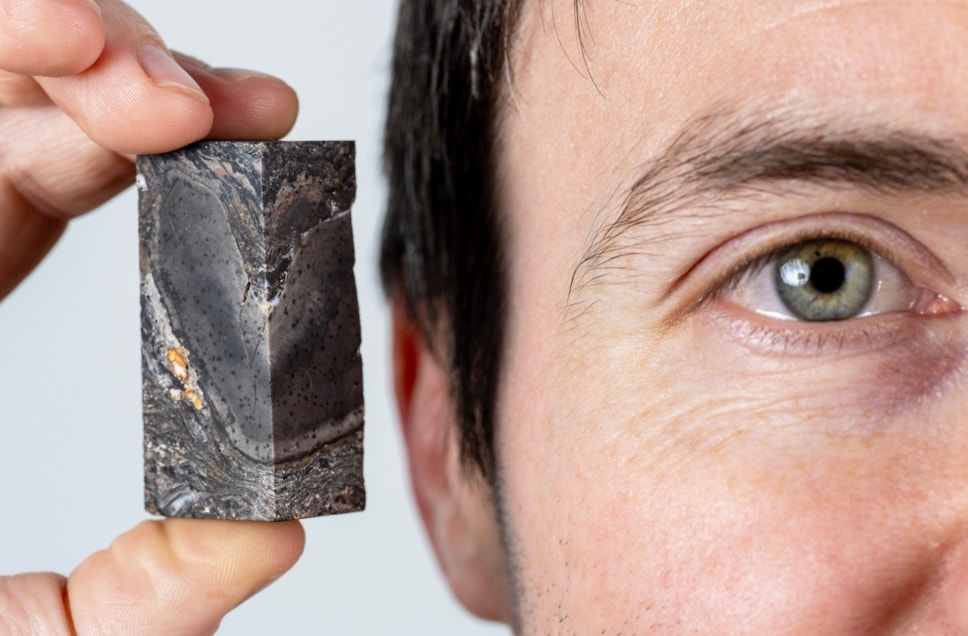
410 million year old fossil which defies classification enters collection of National Museums Scotland
UNDER EMBARGO UNTIL 7pm GMT, Wednesday 21st January
A 410 million year-old fossil from Aberdeenshire in Scotland which scientists have identified as being a ‘new’ form of life, distinct from plants or fungi, has been added to the collections of National Museums Scotland.
A selection of images is available here
The genus ‘Prototaxites’ had previously been thought to be an early type of fungus. However, in a new paper published in Science Advances, researchers from the University of Edinburgh and National Museums Scotland have shown that this fossil is from an evolutionary path of large complex life which is neither fungus nor plant, and which died out around 360 million years ago.
The fossil comes from the Rhynie chert, a uniquely preserved prehistoric terrestrial ecosystem named for the nearby village of Rhynie.
Prototaxites was the largest organism on land 410 million years ago. Growing as high as eight metres, it towered over plants and animals.
Lead co-author Dr Sandy Hetherington, Research Associate at National Museums Scotland and Senior Lecturer from the School of Biological Sciences at the University of Edinburgh, said:
“It’s really exciting to make a major step forward in the debate over Prototaxites, which has been going on for around 165 years. They are life, but not as we now know it, displaying anatomical and chemical characteristics distinct from fungal or plant life, and therefore belonging to an entirely extinct evolutionary branch of life. Even from a site as loaded with palaeontological significance as Rhynie, these are remarkable specimens and it’s great to add them to the National Collection in the wake of this exciting research.”
Co-lead and first author Dr Corentin Loron from the UK Centre for Astrobiology at the University of Edinburgh said:
“The Rhynie chert is incredible. It is one of the world’s oldest fossilised terrestrial ecosystems and because of the quality of preservation and the diversity of its organisms, we can pioneer novel approaches such as machine learning on fossil molecular data. There is a lot of other material from the Rhynie chert already in museum collections for comparative studies, which can add important context to scientific results.”
Co-first author Laura Cooper, a PhD student from the Institute of Molecular Plant Sciences at the University of Edinburgh, said:
“Our study, combining analysing the chemistry and anatomy of this fossil, demonstrates that Prototaxites cannot be placed within the fungal group. As previous researchers have excluded Prototaxites from other groups of large complex life, we concluded that Prototaxites belonged to a separate and now entirely extinct lineage of complex life. Prototaxites therefore represents an independent experiment that life made in building large, complex organisms, which we can only know about through exceptionally preserved fossils.”
Dr Nick Fraser, Keeper of Natural Sciences at National Museums Scotland said:
“We’re delighted to add these new specimens to our ever-growing natural science collections which document Scotland’s extraordinary place in the story of our natural world over billions of years to the present day. This study shows the value of museum collections in cutting-edge research as specimens collected over time are, cared for and made available for study for direct comparison or through the use of new technologies.”
The fossils will be housed and cared for at the National Museums Collection Centre in the north of Edinburgh.
DOI: 10.1126/sciadv.aec6277
URL: https://www.science.org/doi/10.1126/sciadv.aec6277