
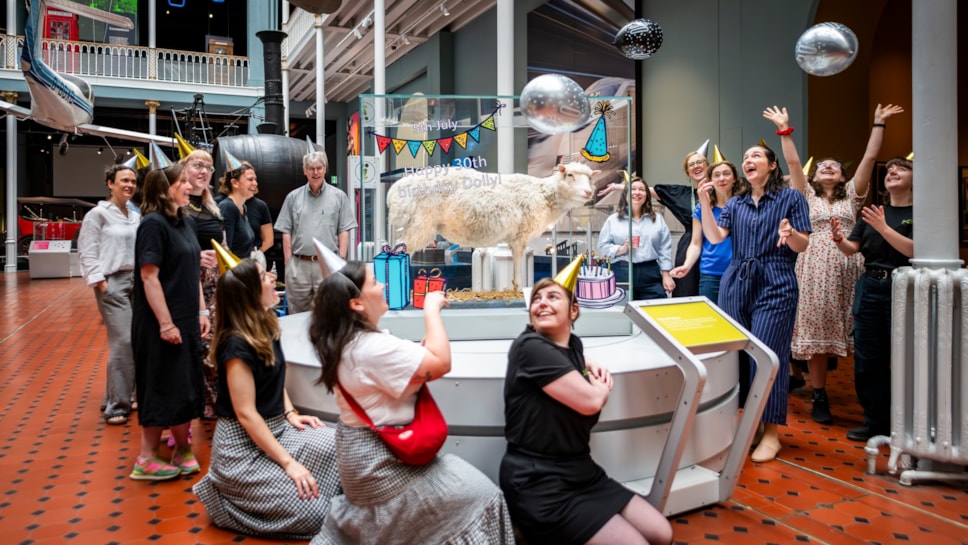
Celebrations for Dolly the sheep’s 30th birthday
As part of the National Museum of Scotland’s Summer Family Fun, family visitors to the Museum on 29 June and 3 July are invited to help celebrate the 30th birthday of the world’s most famous sheep. Visitors will have the chance to write in Dolly the sheep’s big birthday card, and can enjoy a special Dolly-themed cupcake, on sale in the Museum’s cafes from 29 June – 16 July.
Dolly was born on 5 July 1996 at the Roslin Institute just outside Edinburgh, the first cloned mammal ever to be created from an adult cell. Affectionately named after country music legend Dolly Parton, her inception changed what scientists thought was possible and opened new possibilities in medicine and biology. She spent her entire life in Roslin where she gave birth to six healthy lambs and died in 2003 aged six.
On 16 July, the Museum will host an adult event exploring the history and legacy of Dolly. Dolly at 30: The Life and Legacy of a Cloned Sheep will bring together an expert panel to explore the historical significance and ongoing cultural impact of Dolly.
Director of Edinburgh Science Hassun El-Zafur will chair a panel conversation exploring the scientific innovation, historic significance and ongoing cultural impact of Dolly the sheep. Panelists include experts from the Roslin Institute, the University of Edinburgh, the University of Cambridge, and National Museums Scotland. The discussion will be followed by an audience Q&A.
On the night there will also be the opportunity to see recent Dolly-related additions to the museum’s contemporary collections.
Professor Andrew Kitchener, Principal Curator of Vertebrate Biology at National Museums Scotland said:
Thirty years on, Dolly remains an icon of modern science whose story captures the public’s imagination. Dolly has been on display at the National Museum of Scotland for over 20 years and remains one of our most popular exhibits. We look forward to welcoming visitors in July to help us celebrate this milestone birthday for Dolly.
Dolly at 30: The Life and Legacy of a Cloned Sheep
Thu 16th July
18:30 - 20:00: Panel discussion in the Auditorium,
20:00 - 20:30: Pop-up display of newly acquired objects related to Dolly the sheep.
National Museum of Scotland, Chambers Street
This event is free, but booking is required.
This event is for ages 16+.
Tickets can be booked online at Dolly at 30: The Life and Legacy of a Cloned Sheep | National Museums Scotland
This event is supported by the History of Science Society’s Elizabeth Paris Endowment.
Notes to editors
Notes to editors
More information on Dolly at 30: The Life and Legacy of a Cloned Sheep
Our speakers
Chair
Hassun Al-Zafur is Chief Executive Officer of Edinburgh Science Foundation, the organisation behind Edinburgh Science Festival. A former science teacher, he works at the intersection of science, art, and public engagement.
Professor Andrew Kitchener is Principal Curator of Vertebrates at National Museums Scotland, where he is responsible for the care and development of the vertebrate collections, including Dolly the sheep.
Sophie Goggins is Senior Curator of Biomedical Science at National Museums Scotland. She is responsible for the medical collection including her particular specialism, contemporary biomedicine.
Dr Christine Tait-Burkard is a group leader at The Roslin Institute where her research builds on the institute’s legacy of pioneering animal biotechnology established through the creation of Dolly the sheep.
Dr Miguel Garcia-Sancho and Dr Dimitriy Myelnikov is a Senior Lecturer at the Department of Science, Technology and Innovation Studies of the University of Edinburgh. He led the project “Historicising Dolly” which placed the first cloned sheep within a broader trajectory of animal breeding research.
Dimitry Myelnikov is a historian of biology and medicine, and a Teaching Associate at the Department of History and Philosophy of Science, University of Cambridge. As part of the “Historicising Dolly” project, he researched the history of the Roslin Institute and its transition to genetic engineering and cloning research in the 1980s.