
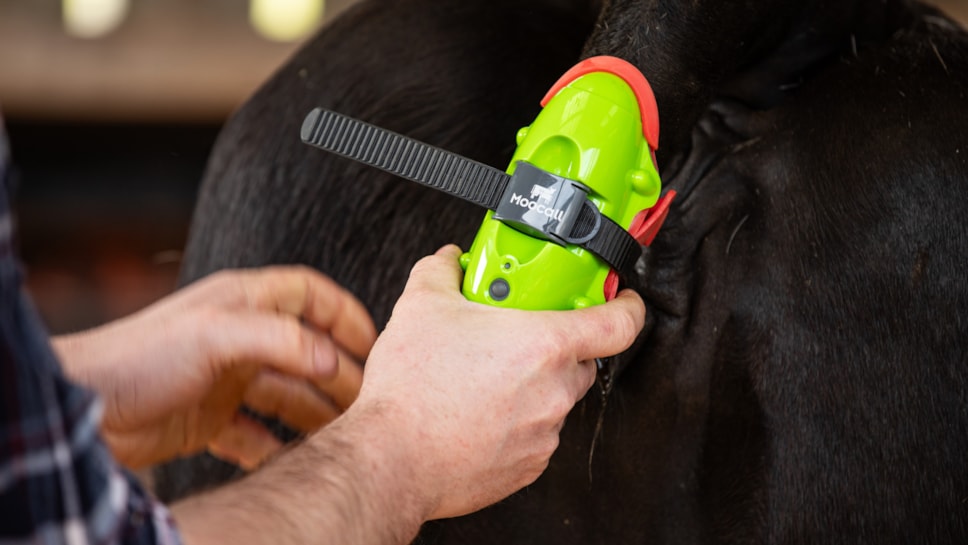
Cow ‘smart watch’ to go on display at National Museum of Rural Life
A new display at the National Museum of Rural Life will explore the future of farming in Scotland, from cutting edge scientific advances to the resurgence of crofting.
Innovations, including wearable technology for cows that monitors an animal’s health and wellbeing, will reveal how science is transforming farming and animal care.
Press images are available here.
Wearable technology, such as a watch or ring that tracks daily health and fitness data, has become a popular accessory. The technology has now been adapted to be worn by cows, allowing farmers to monitor their wellbeing in greater detail than ever before.
A new display opening at the East Kilbride museum in the spring will include a ‘Moocall’, a bright red and fluorescent yellow calving sensor that is attached to a cow’s tail to track fertility and can inform famers when birth is imminent. The distinctive piece of equipment was featured on Clarkson’s Farm. It will be displayed alongside a 'CowAlert’, an ankle sensor that tracks an animal’s step count. Research has shown that cows who walk more are happier, while reduced movements may indicate illness or injury.
Sophie Goggins, Senior Curator of Biomedical Science at National Museums Scotland, said:
“At this time of year many of us are trying to be more active and establish healthier habits with the help of Fitbits and similar gadgets. Applying this technology to help improve animal welfare is just one creative solution developed by researchers and farmers, ensuring happier animals and more efficient and sustainable farming. By displaying these devices in the museum we hope families can learn more about the surprising science behind the food and milk on our supermarket shelves.”
The display is the latest addition to the galleries at the National Museum of Rural Life and help tell the story of Scotland’s rich rural heritage. Visitors to the popular East Kilbride attraction can also visit the historic working farm and see Clydesdale horses, Gina and Anna as well as Highland cattle, Tamworth pigs, sheep and hens. The Ayrshire dairy herd is milked in the dairy each afternoon and visitors can step back in time at the Georgian farmhouse which offers a glimpse into the home life of farmers over 70 years ago.
Notes to editors
Notes to editors
- About the National Museum of Rural Life
Philipshill Road, East Kilbride, G76 9HR
The Museum is open from 10am until 5pm.
Tickets can be booked online at nms.ac.uk/rural-life
Annual Pass – pay once, visit all year
Annual Pass prices
Adult (16+) £12, Over 65’s £11, Concession* £10, Child (5-15) £9, (under 5’s free**)
15% family discount when up to three Child (5-15) tickets alongside up to two Adult, Over 65 or Concession tickets (max 5 tickets total) purchased***
National Museums Scotland members free
National Trust for Scotland members free
Accompanying essential carers free
Discounts available for groups of 10 or more.
School visits free; some workshop charges apply.
* Concessions: Student, Unemployed, Disabled, Young Scot. Valid ID required.
**Additional charge for some events.
***Cannot be used with member tickets or any other discount or offer.
2. About National Museums Scotland
National Museums Scotland is one of the leading museum groups in the UK and Europe and it looks after collections of national and international importance. The organisation provides loans, partnerships, research and training in Scotland and internationally. Our individual museums are the National Museum of Scotland, the National Museum of Flight, the National Museum of Rural Life and the National War Museum. The National Museums Collection Centre in Edinburgh houses conservation and research facilities as well as collections not currently on display.
Facebook: www.facebook.com/NationalMuseumsScotland
Instagram: @NationalMuseumsScotland
Bheireadh Oifis nam Meadhanan eadar-theangachadh Gàidhlig den bhrath-naidheachd seachad do bhuidhinn mheadhanan bharantaichte.
Cuiribh fios do dh'Oifis nam Meadhanan airson bruidhinn air cinn-latha freagarrach.