
Historic tartan archive gifted to the nation will transform understanding of Scotland’s textile heritage
An archive of almost 800 historic tartan samples has been donated to National Museums Scotland. The textiles were produced by J&D Paton, one of the largest tartan manufacturers of the 19th and 20th centuries, and have been gifted to the nation by Stuart Paton, the great great grandson of the firm’s founder.
Press images are available here.
A unique archive, the extensive J&D Paton collection has the scope to rewrite our understanding of tartan. The samples record the firm’s production from its foundation in the 1820s to its closure in the 1960s, including rare examples of tartans woven for women's fashion, textiles created for Queen Victoria and the Royal Family during the Highland revival, military fabrics supplied to the Scottish regiments and previously unrecorded clan tartans.
The firm reached the height of its popularity in the late 19th century with prolific production continuing through both world wars. At its peak, J&D Paton employed around 500 people across four factory sites near Tillicoultry, in Stirlingshire. Family run for five generations, the company produced internationally-renowned tweeds and tartans, winning awards for fine fashion textiles sometimes woven through with silk.
Each sample in the archive is unique, serving as a working record for the identification of clans, patterns and colours essential to the weaving process. This rich library provides a rare detailed picture of the history of mass manufacturing at a time when tartans were expanding into new fashions and global marketplaces. Meticulously cared for by the Paton family for over two hundred years, the collection will now be catalogued and made available for research at the National Museums Collection Centre in Edinburgh.
Dr Mhairi Maxwell, Curator of Modern & Contemporary History at National Museums Scotland said
“Tartan is one of the most recognisable symbols of Scotland and the exceptional J&D Paton collection is of immense importance to ongoing research into the history of the iconic textile. We have only just begun to uncover of the stories woven through this remarkable archive and I’ve no doubt there are many discoveries waiting to be made, all thanks the generosity of Stuart Paton and his family.”
Stuart Paton, former Director of J&D Paton, said:
“I am delighted to find a long-term home for the collection with National Museums Scotland. The donation is made in memory of my godfather Captain Paton a long-time chairman of the company, in the hopes it will become a valuable asset for those researching and learning about Scotland’s textile heritage for generations to come.”
National Museums Scotland holds one of the largest and most diverse tartan collections in the world spanning over three centuries of production history. Discover more at nms.ac.uk/discover-catalogue/tartan.
Picture caption:
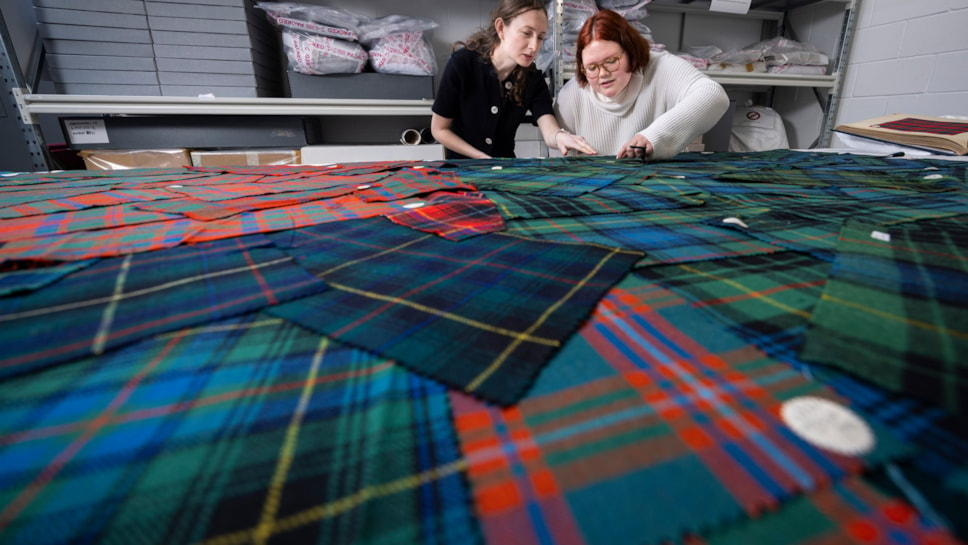
University of Glasgow students Lilly and Layla examine the historic Paton tartan archive, recently acquired by National Museums Scotland.
Photo © Duncan McGlynn
Notes to editors
About National Museums Scotland
National Museums Scotland is one of the leading museum groups in the UK and Europe and it looks after collections of national and international importance. The organisation provides loans, partnerships, research and training in Scotland and internationally. Our individual museums are the National Museum of Scotland, the National Museum of Flight, the National Museum of Rural Life and the National War Museum. The National Museums Collection Centre in Edinburgh houses conservation and research facilities as well as collections not currently on display.
Facebook: www.facebook.com/NationalMuseumsScotland
Instagram: @NationalMuseumsScotland
Bheireadh Oifis nam Meadhanan eadar-theangachadh Gàidhlig den bhrath-naidheachd seachad do bhuidhinn mheadhanan bharantaichte. Cuiribh fios do dh'Oifis nam Meadhanan airson bruidhinn air cinn-latha freagarrach.