
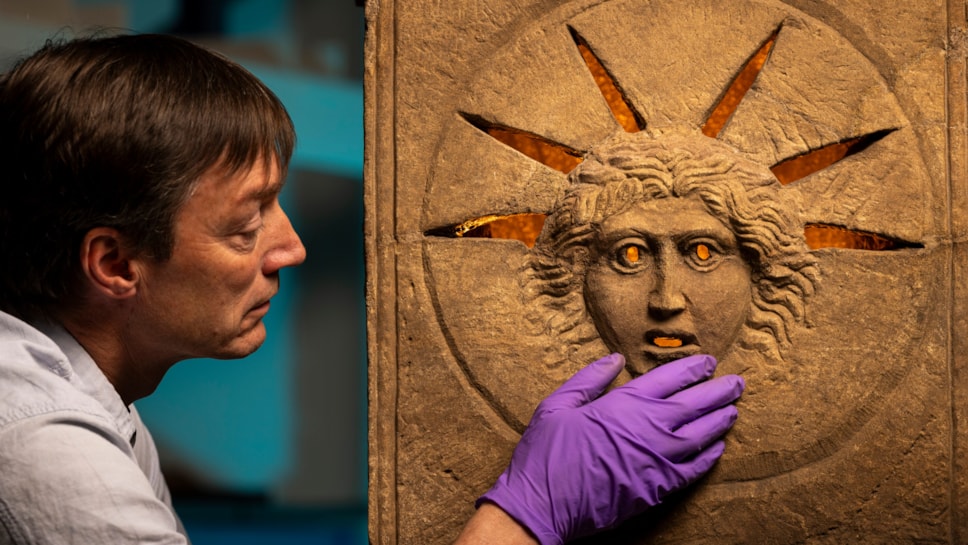
Rare Roman altars acquired for the nation will go on display in the autumn
Two spectacular stone altars from a Roman fort near Edinburgh have been acquired for the National Collection ahead of a major exhibition at the National Museum of Scotland. The rare carvings are among the finest examples of sculpture from Roman Britain and will go on display for the first time in Roman Scotland: Life on the Edge of Empire (14 November 2026 – 18 April 2027).
Press images are available here.
Video available for press use includes:
- An interview package with exhibition curator Dr Fraser Hunter alongside the altars
- B-roll of Dr Fraser Hunter discussing the altars
Once the centrepiece of the most northerly known temple to the god Mithras in the whole of the Roman empire, the altars were excavated at Inveresk, East Lothian and are the only examples to be found in Scotland. Dating to the 140s - when southern Scotland was reoccupied under Antoninus Pius - they reveal new details about the lives and beliefs of soldiers on the frontier.
Mithras was a secretive, male-only religion which celebrated the triumph of good over evil and light over darkness. The altars would have been a striking focal point in the underground Mithraeum.
One depicts the face of the sun god Sol and would have been illuminated from behind so that in the low light of the temple, worshippers would have seen his eyes, mouth and the rays of his solar crown glowing. It also features carvings of the four seasons - depicted as female deities - conveying the passage of time, another prominent theme within the cult of Mithras.
The second honours Mithras himself and is adorned with carvings linked to the god Apollo, another god of light – a griffin, lyre and plectrum - as well as two ravens, which are often seen in Mithraic imagery.
Both altars were dedicated by a legionary centurion whose name was abbreviated on the altar as G CAS FLA, probably Gaius Cassius Flavianus. He was probably in command of the fort garrison at the time. Evidence for Mithras in Britannia mostly dates to the third century, but these earlier altars demonstrate that his cult was flourishing within the army by the middle of the second century, as it was on the continent.
The altars had broken into fragments during their long burial and have undergone extensive conservation work to reconstruct them and prepare them for display. During the process, conservators identified traces of paint on the carvings, revealing that they would originally have been painted in vibrant colours.
Dr Fraser Hunter, Principal Curator of Prehistory and Roman Archaeology at National Museums Scotland said:
“These stunning altars really bring the beliefs of the Roman frontier to life. The quality of the carving, traces of paint and dramatic lighting effects show they were impressive and expensive monuments. The cult of Mithras represented the triumph of good over evil and gave soldiers a sense that there was a purpose to their world and a life after death. I’m sure visitors will be amazed by them when they can see them up close in our new exhibition, Roman Scotland: Life on the Edge of Empire.”
Roman Scotland: Life on the Edge of Empire will tackle the common misconception that the Romans never got beyond Hadrian’s Wall. The famous landmark is often thought of as the northernmost reach of the Romans in Britain. However, three times the Empire extended its reach much further north, up to Scotland’s central belt and deep into north-east Scotland.
The Antonine Wall was built across the narrowest part of Scotland from Forth to Clyde, with additional forts along the coasts to east and west. Inveresk was one of these, and grew to became a major centre with a substantial population.
Recent excavations at Inveresk have transformed our understanding of the site, highlighting its significance in the story of Roman Scotland. Finds from the site will be displayed together for the first time, shedding new light on the Roman occupation in Scotland, and demonstrating how this significant frontier outpost was supplied from across the Empire, and the impacts this occupation had on the local population.
This exhibition is made possible with the support of the Roman Scotland Exhibition Supporters Circle.
Notes to editors
About National Museums Scotland
National Museums Scotland is one of the leading museum groups in the UK and Europe and it looks after collections of national and international importance. The organisation provides loans, partnerships, research and training in Scotland and internationally. Our individual museums are the National Museum of Scotland, the National Museum of Flight, the National Museum of Rural Life and the National War Museum. The National Museums Collection Centre in Edinburgh houses conservation and research facilities as well as collections not currently on display.
Facebook: www.facebook.com/NationalMuseumsScotland
Instagram: @NationalMuseumsScotland
Bheireadh Oifis nam Meadhanan eadar-theangachadh Gàidhlig den bhrath-naidheachd seachad do bhuidhinn mheadhanan bharantaichte.
Cuiribh fios do dh'Oifis nam Meadhanan airson bruidhinn air cinn-latha freagarrach.