
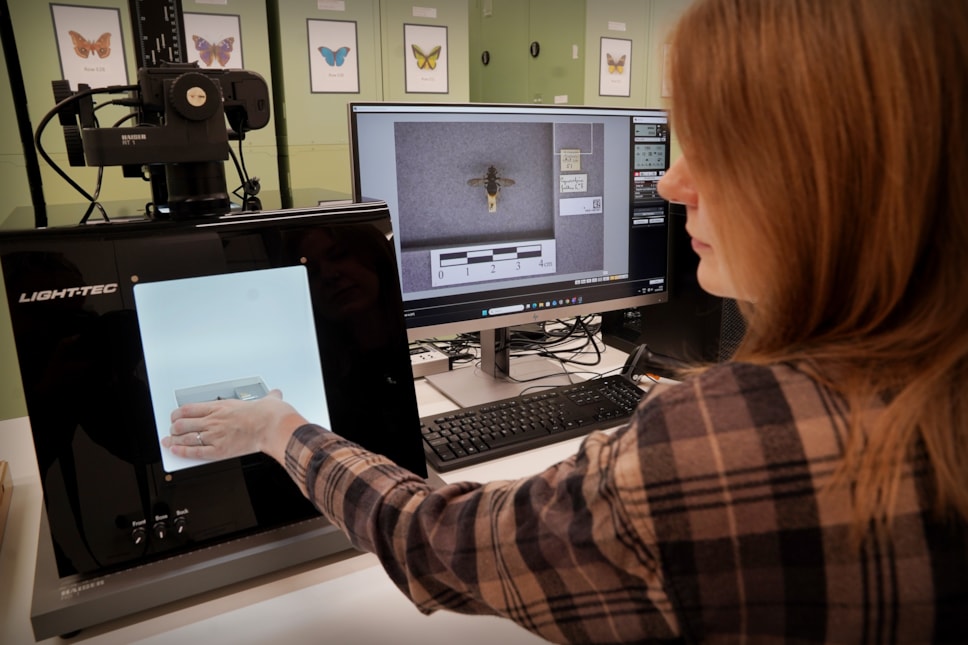
127 year-old fly launches major digitisation project in Scotland
As Scotland's Climate Week gets underway, a 127 year-old hoverfly is among the first insect specimens to be digitised as part of a major new project led in Scotland by National Museums Scotland and Royal Botanic Garden Edinburgh.
Please find a selection of images here
The specimen is a Pine hoverfly (Blera fallax), which entered the Museum's collection in 1899. Blera fallax became critically endangered in Scotland and almost disappeared from the wild by the 2000 before successful efforts were made to reintroduce it in the wild in the Cairngorms National Park.
The DiSSCo UK project in Scotland aims to create approximately 700,000 digital records of specimens held in Scotland’s natural science collections. The project in Scotland will initially run for two years and will see more than 250,000 insects from National Museums Scotland and 388,000 herbarium specimens from the Royal Botanic Garden Edinburgh become digitally accessible to all.
The value of the project in documenting Scotland's natural history is illustrated by the way in which plant specimens from the same region are also being digitised by Royal Botanic Garden Edinburgh, such as Scots pine (Pinus sylvestris). The Scots pine of the Caledonian Forest is a key species for the habitat of the Pine hoverfly, with the insects using rot holes in the trees for the development of their larvae. The specimen in the Herbarium of the Royal Botanic Garden Edinburgh was collected in Aviemore in 1975.
Dr Vladimir Blagoderov, Principal Curator, Invertebrates at National Museums Scotland, said:
“It's very pleasing to have started work on this important work digitally documenting and making accessible this really useful and valuable information about Scotland's natural environment and how it has changed and will continue to change over time."
DiSSCo UK [https://dissco-uk.org/] (Distributed System of Scientific Collections UK), is a £155 million, 10-year national programme to digitise and connect the UK's natural science collections. The programme is funded through the UKRI Infrastructure Fund and delivered by the UKRI Arts and Humanities Research Council (AHRC) in partnership with the Natural History Museum and over 100 partners across the UK.
In addition to material from the Scottish national collections, the project will also see digital records created for 85,000 plant specimens held by Glasgow Life, 1200 insects from The Hunterian, 2400 specimens from Shetland Museum & Archives including plants, algae and fungi as well as 1400 plant, lichen and moss specimens from The James Hutton Institute in Aberdeen. It is hoped that future phases will encompass more of the collections of existing participants and also widen in scope to include more of Scotland’s natural science collecting institutions.
Notes to editors
About DiSSCo UK
DiSSCo UK (Distributed System of Scientific Collections UK) is a £155 million, 10-year national digitisation programme. It is delivered through the Arts and Humanities Research Council (AHRC) in partnership with the Natural History Museum and over 100 partners across the UK.
UK natural science collections hold more than 140 million items spanning an incredible 4.6-billion-year history - researchers use these collections to find solutions to global problems like biodiversity loss and food security.
DiSSCo UK will become a one-stop, dynamic, openly available and easy-to-use online science infrastructure, integrating digital access to UK natural science collections.
Through digitisation, coordination, innovation and community building, we will create a unique infrastructure that builds UK digital capacity and maximises the impact of natural science data.
Find out more and explore what’s already been digitised on the DiSSCo UK website
About Royal Botanic Garden Edinburgh
Royal Botanic Garden Edinburgh is a leading international research organisation delivering knowledge, education, and plant conservation action around the world. In Scotland, its four Gardens at Edinburgh, Benmore, Dawyck and Logan attract around a million visitors each year. It operates as a Non-Departmental Public Body established under the National Heritage (Scotland) Act 1985, principally funded by the Scottish Government. It is also a registered charity, managed by a Board of Trustees appointed by Ministers. Its mission is “To explore, conserve and explain the world of plants.”
About National Museums Scotland
National Museums Scotland is one of the leading museum groups in the UK and Europe, and looks after collections of national and international importance. The organisation provides loans, partnerships, research and training in Scotland and internationally. Our individual museums are the National Museum of Scotland, the National Museum of Flight, the National Museum of Rural Life and the National War Museum. The National Museums Collection Centre in Edinburgh houses conservation and research facilities as well as collections not currently on display.
Facebook: www.facebook.com/NationalMuseumsScotland
Instagram: @NationalMuseumsScotland
Bheireadh Oifis nam Meadhanan eadar-theangachadh Gàidhlig den bhrath-naidheachd seachad do bhuidhinn mheadhanan bharantaichte.
Cuiribh fios do dh'Oifis nam Meadhanan airson bruidhinn air cinn-latha freagarrach.