Cloned sheep that paved the way for Dolly the sheep goes on show at the National Museum of Rural Life
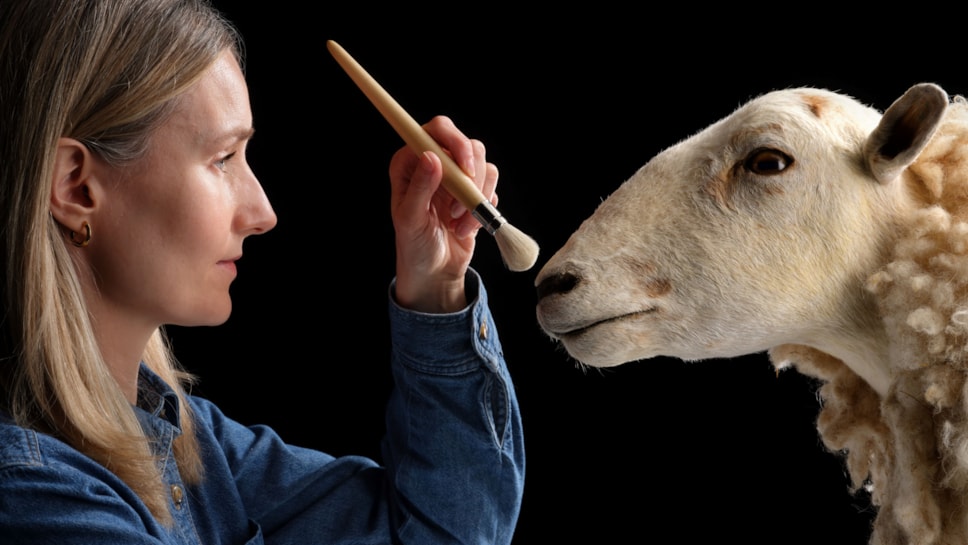
Morag the sheep – an important cloned predecessor to the world-famous Dolly the sheep - has gone on permanent display at the National Museum of Rural Life in East Kilbride as part of a new section exploring the role of science in agriculture, Scotland’s Farming Future.
Press images are available here.
Morag and her identical twin Megan were cloned from the same embryo and were the first mammals to be successfully cloned from differentiated cells. Their births in June 1995 at the Roslin Institute in Edinburgh demonstrated that viable sheep could be produced by nuclear transfer from cells which have been cultured in vitro.
This technical breakthrough that produced Morag and Megan made Dolly the sheep possible. Dolly was the first mammal to be cloned from an adult cell, part of the Roslin Institute’s research into producing genetically modified farm animals. Her birth in July 1996 made headlines around the world.
Professor Andrew Kitchener, Principal Curator of Vertebrate Biology at National Museums Scotland said:
“The birth of Dolly the sheep is remembered as one of the great scientific breakthroughs of the late 20th century, but that historic moment wouldn’t have been possible without the arrival of Morag and her twin. Without them, there would not have been Dolly. It’s very fitting that Morag forms the centrepiece of this fascinating new display at the National Museum of Rural Life, exploring the role that cutting-edge science can play in farming.”
Morag is one of the highlight objects in a new display at the National Museum of Rural Life which explores the future of farming and reveals how cutting-edge technology is being used to solve centuries-old problems. Innovations in artificial intelligence, robotics and precision agriculture could transform how food is produced in Scotland, bringing agriculture into urban areas and revolutionising the role of farmers.
The display examines three main themes: animal welfare, large-scale agriculture and small-scale food production. Visitors can view objects representing precision farming which uses data to better understand the land and crops. This could involve using drones and GPS technology to map the land and take readings about soil and plant health. The information can then be used to calculate exactly how much water, pesticide or fertiliser is needed, reducing waste and unnecessary use of chemicals.
The display also tells stories of crofting in Scotland today, a practice which often focuses on sustainable production while employing contemporary innovation and research. This blend of old and new is explored through objects relating to salt, tea, milk, seaweed and honey – all made in Scotland and sold by specialist retailers, sometimes globally. These products reflect changing attitudes and increasing awareness about where our food comes from and how it reaches us.
The Rural Life gallery upgrade has been generously supported by the Wiseman Family Charitable Fund, and by a legacy gift from Ian and Margaret Fleming.
Notes to editors
1.About the National Museum of Rural Life
National Museum of Rural Live
Philipshill Road, East Kilbride, G76 9HR
The Museum is open from 10am until 5pm.
A museum, historic farmhouse and working farm, the National Museum of Rural Life in East Kilbride explores the land, people and ways of working that have shaped Scotland's rural history. On display in the museum is Scotland's largest collection of tractors, combine harvesters and farming machinery, while the farm is home to Ayrshire, Aberdeen Angus and Highland cattle, Tamworth pigs, sheep, hens and Clydesdale horses. Lanarkshire's Reid family lived in the Georgian farmhouse for ten generations, and rooms are as they would have been in the 1950s.
Tickets can be booked online at nms.ac.uk/national-museum-of-rural-life
Annual Pass – pay once, visit all year: Adult (16+) £12.50, Over 65’s £11.50, Concession* £10.50, Child (5-15) £9.50, (under 5’s free**)
15% family discount when up to three Child (5-15) tickets alongside up to two Adult, Over 65 or Concession tickets (max 5 tickets total) purchased***
National Museums Scotland members free
National Trust for Scotland members free
**Additional charge for some events.
***Cannot be used with member tickets or any other discount or offer.
2. About National Museums Scotland
National Museums Scotland is one of the leading museum groups in the UK and Europe and it looks after collections of national and international importance. The organisation provides loans, partnerships, research and training in Scotland and internationally. Our individual museums are the National Museum of Scotland, the National Museum of Flight, the National Museum of Rural Life and the National War Museum. The National Museums Collection Centre in Edinburgh houses conservation and research facilities as well as collections not currently on display.
Facebook: www.facebook.com/NationalMuseumsScotland
Instagram: @NationalMuseumsScotland
Bheireadh Oifis nam Meadhanan eadar-theangachadh Gàidhlig den bhrath-naidheachd seachad do bhuidhinn mheadhanan bharantaichte.
Cuiribh fios do dh'Oifis nam Meadhanan airson bruidhinn air cinn-latha freagarrach.