
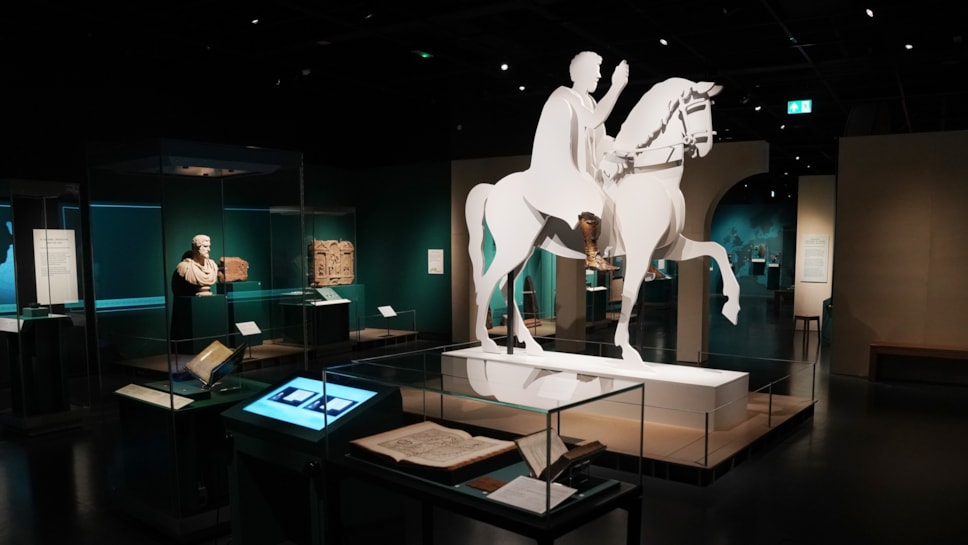
Huge gilded statue of Roman Emperor Antoninus Pius once stood in southern Scotland
New research has revealed that a massive monument to the Roman Emperor Antoninus Pius once stood in the Scottish Borders. The grand sculpture is the only known example from Scotland and the findings rewrite our understanding of the northern-most frontier of the Roman Empire. The statue has been reconstructed using its surviving gilded bronze leg ahead of a major new exhibition opening at the National Museum of Scotland this weekend; Roman Scotland: Life on the Edge of Empire.
Press images are available here.
Discovered in a bog in Milsington near Hawick in 1820, the larger than life-sized lower leg with a boot-clad foot dates to the AD 140s and is one of the most striking treasures from Roman Britain in National Museums Scotland's collection.
For over two centuries it was assumed to be loot from further south, perhaps the major Roman town of York, Eboracum. Experts now believe it came from a statue of Pius on horseback, similar to the famous surviving monument to his successor Marcus Aurelius in Rome and erected to mark the conquest of southern Scotland.
A wider study of statue fragments from the Roman frontier showed that bronze imperial statues - including equestrian ones - were erected in frontier forts, thus making a Scottish location for this particular statue suddenly more feasible.
Furthermore, the way the leg was removed suggests the deliberate Roman dismantling of a valued sculpture as they withdrew from southern Scotland in the AD 160s or 180s, rather than a local act of revenge. It was carefully removed, not brutally hacked off.
Examination of the top of the leg has found that there are no cut marks, but rather it remains exactly as it was cast. The absence of gilding around the knee shows that this area was covered by a tunic or cloak, with lumps around the top which infilled the folds of the tunic and stuck the leg to it.
This contrasts with examples of statues being deliberately destroyed after a battle, when an emperor’s memory was condemned, or when they were chopped up for scrap, typically resulting in irregular fragments on a much smaller scale.
Such careful removal and burial is found widely in Roman Scotland when the Antonine conquests were abandoned, such as the careful burial of Antonine Wall inscriptions and of the Inveresk Mithras altars, which are also on display in the exhibition.
Once curators had established that the statue was likely to have been erected in Scotland, they looked to answer the question of who it depicted. Just one emperor paid particular heed to his Scottish victories - Antoninus Pius. His conquest of southern Scotland was the only foreign adventure that he commemorated with the title Imperator, a battle-honour meaning ‘commander’ which marked an emperor’s victory.
Dr Fraser Hunter, Principal Curator of Prehistoric and Roman Archaeology at National Museums Scotland said:
"This really turns on its head our understanding of Rome’s second attempt at conquering Scotland. This was a big deal for the Emperor, something which was worth celebrating. It offers us a tantalising glimpse into the kind of grand monuments which once stood in southern Scotland and shows the importance Pius placed on his victories in Scotland. But it begs the question ... where is the rest of the statue?"
Roman Scotland: Life on the Edge of Empire will explore the experiences of life on a frontier, from the soldiers who tried to conquer this land and the families and communities who lived around each military base, to the locals whose lives and lands were threatened by the Roman invasion, and who had to find ways to deal with this threat.
The exhibition is made possible with the support of the Roman Scotland Exhibition Supporters Circle.
A press release giving full details of the exhibition is available here.
Roman Scotland: Life on the Edge of Empire
14th November 2026 – 18th April 2027
National Museum of Scotland, Chambers Street, Edinburgh, EH1 1JF
Tickets are available to book at nms.ac.uk/RomanScotland
Notes to editors
About National Museums Scotland
National Museums Scotland is one of the leading museum groups in the UK and Europe and it looks after collections of national and international importance. The organisation provides loans, partnerships, research and training in Scotland and internationally. Our individual museums are the National Museum of Scotland, the National Museum of Flight, the National Museum of Rural Life and the National War Museum. The National Museums Collection Centre in Edinburgh houses conservation and research facilities as well as collections not currently on display.
Facebook: www.facebook.com/NationalMuseumsScotland
Instagram: @NationalMuseumsScotland
Bheireadh Oifis nam Meadhanan eadar-theangachadh Gàidhlig den bhrath-naidheachd seachad do bhuidhinn mheadhanan bharantaichte.
Cuiribh fios do dh'Oifis nam Meadhanan airson bruidhinn air cinn-latha freagarrach.